Brainstorm some ideas by creating a mind map and asking other people for inspiration.
Check no-one else is using the name you want.
Do you have a unique first name or surname. If you do try and include it into the business name.
Make a list of photographic terms and see if one jumps out at you.
Don’t Do what everybody else is doing. Try to make your name stand out.
When choosing my name Lucy and the Lens step 1 and 4 were the ones I used the most then I got a logo and cartoon me designed by @emiliaclarecreates check out her Instagram.
This next article is one i wrote for my Final Project for My Photography MA with a few minor adjustments.
The aim of this project was to examine the role of photography in illustrating and reflecting aspects of cultural life in this country. This was executed by focusing attention on two key themes performativity and identity. Performativity can be defined as the interdependent relationship between words and actions while identity in photographic terms can be defined as how people see themselves and how they see themselves in relation to others. I have examined these themes through the eyes of a variety of performers whose views about themselves and their art informed my work. I desired to show this through my photography. I seeked to answer the question does performativity and performance impact identity through photography?
The term Performativity was first
introduced by the philosopher J.L. Austin which he defined as, “The symbiotic or interdependent relationship
between words and actions that the performative encompasses is a key aspect of
performance art, with theorists and philosophers examining the role of actions,
gestures and artistic decision-making through the idea of performativity.” He
went on to say that, “Performance art can be photographic based artworks in which
the actions of artists, performers or the audience are conveyed.” ( https://www.tate.org.uk/art/art-terms/p/performativity) Conveying ‘the actions of artists and
performers is what I primarily want to show through my photographs and practice-based
research. Capturing performance through photography has been used since its
invention right up to the fashion today for ‘Selfies’ on mobile phones. (https://www.tate.org.uk/whats-on/tate-modern/exhibition/performing-camera) The selfie is
often a form of self-expression depicting a person how they desire to be seen
for wider consumption. Arguably like photography in general, the selfie can
also be seen as showing a snippet of one’s identity.
In
one sense it can be argued that all photography is an exploration of identity
and or of place. In photographic terms identity can be seen as an expression of
individuality and the traits that set individuals apart from others and perhaps
just as importantly, what defines them as being part of a distinct group. This can be shown in a myriad of ways, such
as “our choice of hairstyles, clothing, and make-up
through to marks on our bodies including paint, tattoos, scars and piercings.”
And of course, through ethnicity and race.
Eight of the subjects of my shoots are actors and actresses so my starting point when capturing identity with these subjects was to take headshots because these are a trademark of their chosen profession. Although Headshots do not in themselves identify a person’s occupation, it can be argued that headshots become a part of their identity because it becomes natural to them throughout their career. I believe that headshots can capture the personality of the performer through different emotions but also need to be neutral in the sense that potential employers can picture them in varied roles. Headshots are more representative of the perceived identity of the performers, so casting directors and agents can see them as an individual. In the headshots the actors aren’t playing any character, so they adhere to be the most authentic version of the actor’s true self.
Another technique I used during my shoots was asking my performers to bring props that represent in some way, who they are. It became rather noticeable during shooting that some of my performers had a vulnerable aspect to their identity that you wouldn’t expect from them. They used scarfs and jackets to hide parts of their face to represent the past shyness they had before performing improved their confidence.
When I look at identity in performers, I am trying
to discover how they see themselves through photography and also perhaps
capturing the memories they have made and are making during their past or
current performances. I desired to show them in two different personas. One
Performed and one not. Either way they have a story to tell.
As Stuart Freedman (Photographer) recently declared, we need “a return to a storytelling in
photography as rigorous in thought and research as it is beautiful in
construction and execution.” (Campbell, D: 2010) This is relevant because I decide
to allow my subjects to tell their own story about identity and performativity
and I gave their stories a face through having them record journal style excerpts
about their performing identity and photographing them performing in the studio
and taking natural portraits of them with the aim of capturing a sense of who
they are.
A quote from the
photographer Loretta Lux in the book Imaginary Portraits by Francine Prose
(2005) states “ A work of art that focuses on a child seems to burrow under our
skin, tunneling back through time and memory to a world whose details we long
to recall, yet cannot, and so we invent a myth that only inserts another layer
between us and what we are trying to recapture.” This is relevant for me because
I was trying to capture the essence of who the person is and how they became a
performer showcasing aspects of their memories in my photography.
Normally when doing a shoot, I will
give directions to my model. However, in looking at their own identity I wanted
to use the studio as a space to give them a platform to express themselves with
little direction. “Space-whether a suspended pause, a blank area, an empty room
or a limitless cosmos-performs.” (Portia Hannah:2011: Performance
Perspectives:54). Peter Brook (Theatre Director) stated that I can take any
empty space and call it a bare stage. A man walks across this empty space
whilst someone else is watching him, and this is all that is needed for an act
of theatre to be engaged (Brook 1968:11: Performance Perspectives:58). I wanted
to use the studio as an empty space to give them the freedom to express
themselves as naturally as possible. If I told them what to do and how I wanted
it done it would become more about how I wanted them to be perceived and not
how they wanted to be perceived. I wanted their actions and responses to be as
natural and as spontaneous as possible and not manipulated or staged by me. I was
looking for authenticity.
In my search for authenticity I am
also aware as a woman that gender plays a very important role in unpacking
one’s identity. Judith Butler sums up the issues surrounding gender identity.
“Gender reality
is performative which means, quite simply, that it is real only to the extent
that it is performed. It seems fair to say that certain kinds of acts are
usually interpreted as expressive of a gender core of identity, and that these
acts either conform to an expected gender identity or contest that expectation
in some way” (Butler in Loxley, J:2007: p118). In using both male and female
performers in my work I want to see whether the performers adhere to their
normative gender identities or does the true self come out.
The academic Patrice Pavis states, “The more the camera has to go in search of an actor who pretends to not be aware of it, and to exist without it, the more naturalistic and documentary the acting seems (Patrice Pavis: 2003:117). In my images of Sophie an actress shown below you can see how she, although performing for the camera has the ability to act natural as though the camera isn’t even an element. She is relaxed and it allows the viewer to delve deeper into her personality, trying to discover her identity in their eyes. No props are used but I have employed them in some instances with my performers to see whether or not their self-perception changes.
The Philosopher Giles Deleuze states that “Behind
the mask… are further masks, and even the most hidden is still a hiding place,
and so on to infinity. The only illusion is that of unmasking something or
someone (Howell, A: 1999:16). That we can truly unmask someone is probably an illusion,
but we can surely unmask aspects of someone’s identity and sometimes the mask
is used for that purpose.
The Theatre director Jacques Lecoq
uses masks in his teachings, firstly in a neutral sense to put the actor in a
state of discovery and then in an expressive sense in order for the actor to
experience an emotional and expressive intensity which enables them to
challenge themselves through playing the mask character and counter masked
character (Jacques Lecoq: 2002:38-61).
In the fifth shoot I did for the
project with Anna an actress I used the expressive mask to see what she would
do and repeated the process with another four of my subjects. I discovered that
you can learn a lot about a person by putting them in a mask because this gives
them an expressive platform in which to create a character depicting how they
see themselves as a performer, exaggerating their usual persona. Using a mask
can push them to see how far they can discover themselves.
Also, it works equally well to
strip the performer back into a neutral outfit (Black or White) as you see who
they are without the props and behind the physical or metaphorical mask. The
only direction I gave was for them to perform in any way they wished. This is
important for authenticity as I wanted them to show me how they see themselves
both naturally and as a performer. I asked each performer to bring a prop that
means something to them to the studio. Then I tried some experimentation with
masks to see what the performer would do with a mask on to represent whether
they hide aspects of their identity or embrace them. Seeking an aspect of
identity can be seen in the work of four noted photographers I have looked at
while undertaking this project.
In The Article New Writing On Jane
Bown (https://photoworks.org.uk/jane-bown/) by
Luke Dodd it is stated that “Many photographers talk of the portrait in terms
of a contract with the subject, implying that the greater the rapport, the
better the finished result. Jane liked it when there was a ‘spark’ with
the sitter, but it was by no means necessary for her to produce startling
results. The famous picture of Mick Jagger laughing was taken as Jane
worked around him and the interviewer with very limited time. And
sometimes a rapport hindered her: the first time Jane photographed Bjork
(having absolutely no idea who she was) it is obvious from the contacts that Jane
had to really work at it because both of them were having too much fun – she
exposed four rolls of film, always a sign that things were not ideal.” She shot
Samuel Beckett with directness and candour after cornering him in a dark alley.
In Jane Bown’s portraits shown through the above hyperlinks
we can see that she develops relationships with her subjects in order to
capture their innermost emotions. She
tries to create a connection with the subject, and she won’t stop shooting
until she has that glimmer of a special moment.
However, Bown caught Samuel Beckett
off guard, with this photo the aim is to expect the unexpected. Despite having
no rapport with Beckett at all she perfectly captures a sense of him and that
is what makes this image so special. As you can see from my images below my subject’s
identity and personality is depicted through their emotions, through a smile, a
look of sadness or a simple hand gesture. I haven’t asked my performers to do
this I have built my own rapport and developed a connection between the subject
and the camera. These moments have happened naturally as the shoot has
developed.
The Dutch photographer Rineke
Dijkstra places an emphasis on capturing the vulnerable
side of her subjects. “With young people everything is much more on the
surface—all the emotions,” the artist observed. “When you get older you know
how to hide things.” (http://www.artnet.com/artists/rineke-dijkstra/) In this project I have
photographed both young and old performers and can see that difference between
them Dijkstra mentions. The older performers are more subtle in expressing
their emotions. Each performer brought their own kind of style to the shoot and
had a completely different take on how they expressed themselves, irrespective
of age. I needed the studio to be a platform for self-expression which is why I
kept it neutral so their entire focus would be on the performer.
The Third
photographer I have looked at Anouk Kruithof created a photographic project
titled Becoming Blue, where she
made constant but minor physical interventions to influence the person being
portrayed. This was done so that her photos capture the subject’s gestures and
facial expressions, interaction to the unknown, irritation or stress. Reactions
out of the blue. poses and gestures of the persons portrayed obviously
contradict such associations – a stylistic means that Kruithof deliberately
chooses in order to visualize different emotional and psychological states
during a process of surprise or even confrontation. (2006-2009)
Anouk’s work is all about adding an element of surprise
to the shoot and catching the subject off guard. Her props if you could call
them that were physical interventions through the use of pins. My interventions
in the shoot were more subtle because as well as capturing the subjects in
performance I was also capturing them off guard just as we were having a
conversation about something. They
brought props themselves such as scarfs, mirrors, dream catchers and I brought
masks to the shoot unknowing what the subject would do with them, which creates
an exaggerated persona, of their identity.
The masks seemed to become something Shakespearean in nature for some of
the subjects and I asked my subjects to perform for me in the studio.
For nearly a
decade of her life, my final photographer Norma I. Quintana (2014)devoted every summer to a
group of people few ever get to capture through a candid lens: circus performers The goal of her book Circus: A Traveling Life was to shine a
light on this, “sense of family and tradition and culture and love of
performance” that pervaded her behind the scenes experience of the circus. And
while some images might seem sombre, especially knowing that Circus Chimera is
no more, she sees the images as a celebration.
Norma’s
work is all about an intimate delve into the lives of circus performers. The
performers look at her as if they know her and have done for a long time. She
got to know them over a 10-year time period and captured, those moments you
wouldn’t normally see at times when they weren’t performing. I feel in my work
I created quite a personal experience in that I had conversations with the
performers as I was snapping and captured them at times when they were not
performing. In doing so I was able to build a rapport and taking the performers
outside their comfort zone off the stage to create a more intimate feel with a 1-2-1
shoot. I got them to perform as naturally as possible and listened to their
stories and collected information about how performing is a part of their
identity.
I chose to use two different ways of collecting data for
the project. One was using an anonymous questionnaire about my two key themes.
Here are my findings: 70% of my participants were female so there might be a
slight bias in some of the results because it wasn’t an even split. I also
asked how long each performer had been performing which is important because in
doing that you can see how long it has been a part of their identity for.
First of all, I asked each performer what they believed
performativity to be. The best of the
responses ‘being able to express a
completely different part of yourself and show something new and exciting to
the world’, ‘expression through entertainment or art’, ‘the way in
which people perform and adapt themselves into their role during a performance’.
Subject 5 perfectly captures the essence of
what my project aims to reflect in his definition he says, ‘Sharing an idea,
experience, emotion, some part of your life with the world’. This statement he
has made states that performativity is demonstrated through parts of your
identity and I want to know if they can both work in synchronisation. I am
figuring out if we can capture identity through performance and this sums it
up.
54% of participants thought gender
influenced the type of performer you are and 70% believe gender affects the
roles they have played. Out of those 70% 3 were male and stated that they would
be unlikely to play a female role based on them looking too masculine but of
the women that agreed, this response jumped out at me because it gives a more in-depth
reason why ‘In
classical dancing the roles are typically very gender-specific, generally with
the males in supporting roles to the females. However, that being said, due a
lack of male dancers I have previously had the opportunity to dance in
styles/roles which would traditionally be classed as male.’ This illustrates
that Gender plays a big role in performance identity because you are mostly restricted
in the type of performance you can do or role you can play.
In one of the lectures in a focus group it was suggested
to me that performers might mask their identity, so I asked in the
questionnaire what my subjects thought and 70% of them said No. Those
responders said You can’t hide
what you look like to an extent, but when I’m performing ‘I’m not me, I as a
person am quite shy and when I am performing I don’t take this part of me on
stage with me’, ‘You are always the same person and
will express the moves in a certain way, dependent on your personality.’ ‘It is part of me as I have danced all my life.’
‘It’s pretty much my life’. ‘I think that performing enables me to have
another facet to my identity, in that when I am performing, I am not
necessarily acting as myself. Yet there is an aspect of my personality which
enjoy performance making it a part of who I am.’ ‘Performing is part of my identity. Acting, singing, martial arts and
music have all helped to shape the person I have become.’ ‘Being a performer is what I am. It’s what I
constantly think about, it’s how people perceive me.’
My final question in the
questionnaire is the one I’ve been aiming to answer in the duration of this
project ‘Can Photography capture identity in a performance?’. Of all the
questions I asked this was the most unanimous yes with 92% of the subjects
agreeing on this. They answered, ‘Through capturing
performances and personalities’, ‘in emotion’, ‘Possibly, if it is well executed by both the photographer and the model’, ‘the way
in which I dance is part of my identity’. Any photograph of a dancer will
capture the dancers identity, I
believe that in any character you can see a mark of the actor behind the role, Yes, when performing I feel the most like a woman and dancer and seeing
myself mid-performance in a photograph enhances that. The two most in-depth
responses as follows capture the essence of what my project is all about.
‘The
expression of a performance is a visual act. In this way, I believe that the
individual and personal nature of performance can be captured by an image, to
display a person’s identity and attitude towards their performance.’
‘A
photograph can capture the essence, the emotions of that instant. You can see
dynamics within a scene, the characters’ emotions, who the characters are. Even
in music, you cannot hear the music in an image, but you can capture the
emotion the musicians and performers are expressing.” In large measure these
comments summarize much of what I have been trying to achieve with this
project.
I feel that I have managed to capture aspects of the identity of each of my performers through their individual expressions of performance. As Deleuze pointed out you cannot draw out the complete identity but through performativity you can show glimpses of it and this is what I believe I have achieved with this project.
It all started in September 2017 when I’d been out of university for three years. I decided to go to a postgraduate advice event at UCLAN (the university of central Lancashire), looking into studying a master’s in photography.
A few days later I applied hoping to start straightaway. However, I was a little late applying so I waited patiently until September 2018 to officially start my course.
I walked into my first term not knowing what to expect and realising the next year of my life was going to me my biggest challenge yet.
In the first term I studied three modules, two double modules entitled socially engaged art and space, location and territory which both would continue into the second term. The third module was visualising the inviable which was a singular module. The first term all my subjects required me to present my projects in a self-reflective way.
I’m going to start by talking about socially engaged art. “Socially engaged art projects are those that involve forms of social engagement where the participants are directly involved in the creative process” by Stine Marie Jacobsen. For my project I chose to work with fencing and identity and as you may know from one of my previous posts, I am a fencer. This involved a questionnaire and then compiling a pdf with my participants information embedded. In this pdf I had to discuss the concept and talk about my work.
My project focused on a community of fencers at both Preston Fencing Club and UCLAN Knights Fencing Club. The sport of Fencing is the catalyst to examine the key theme of identity and how participating in fencing contributes to that sense of identity. This included showing that fencing is not just a sporting activity, it is very importantly, also a social activity that brings people together and creates a sense of community. and has a positive impact on their everyday lives, including helping them to deal with among other things, their own mental health issues.
It can be argued that all art is socially engaged because it is created to be communicated to or experienced by others. It is community based, collaborative, participatory, dialogic and public art. It involves working with groups of people in a professional capacity. It is an art form that connects with the world around us. It is either politically or socially motivated and can act through the representation of ideas and issues. Social interaction and connective experience ids the key to this type of project. Socially engaged art uses the arena of contemporary art to engage with communities to produce collaborative or participatory projects based around an identified social issue. Pablo Helguera states that “Socially engaged art is a form of performance in the expanded field and as such it must break away from self-referentiality.” You need to engage with others through conversation, collaboration, antagonism (make it confrontational), performance, documentation and trans pedagogy (blends education and art).
This project allowed my subjects to be involved in the process of taking pictures and recording their stories through the questionnaire.
To start I looked at the work of Paul Floyd Blake Paul Floyd Blake’s Personal Best Project.This project focused on young prospective 2012 Olympians.He got them to create Journals to document their thoughts and feelings and photographed them partaking in their prospective sports. He involved his subjects in a participatory way by spending 5 years with them collecting their stories. I tried to do this over about 3 months but used questionnaires where I asked:
1. What Does Fencing Mean to You?
2. How Does Fencing Shape your Identity?
3. Can Fencing be used as a tool of escapism from day to day life in your opinion?
4. What is the most important reason why you fence?
5. Is there anything you take out of your fencing that you can apply to your daily routine?
6. Is there anything else you’d be willing to discuss that might fit into the project?
7. Feel free to add any questions and answers that might help me form this project.
• Blakes images pay tribute to the long slog towards glory that is not usually seen or celebrated, whilst excerpts from the athletes own writings offer insights into their personal hopes and fears. Blake’s approach emphasises the individuals own story and motivations beyond the values and structures of competitive sport, as the title ‘Personal Best suggests’.
Then I looked at Anthony Luvera who worked with the LGBT community.
He worked collaboratively with groups of marginalized people to explore issues related to identity,community, locality and self-representation which is what I aimed to do with my fencing group.
So how did I execute this project:
I started the project by collating questionnaires and getting each individual fencer to fill them out as part of the project. The first person I used in this project was myself as in order to understand photography you must first become the photographed. I am also a fencer, and this is a great way of understanding my own identity through fencing. After collecting the questionnaires from each of my fencers I did some portraits of them to showcase who each person is. I then showed my fencers how to take photographs on their phone and on my camera. At the end of the project I asked a few of my fencers to send me some images that reflected their fencing identity with an object that means something to them. I also had the fencers take photographs of each other in fights and in the way they wanted. One of my fencers even had a clever idea which was discovered late on to do a photo of himself.
No project would be complete without challenges and this one provided me with many. I really struggled with this project as I had trouble getting the questionnaires of the participants and finding the time duringclass to do the images as the majority of my participants were coaches. I also wasn’t allowed to use anylighting due to it being a distraction for the fencers and had to rely on only my camera and natural light. I also had some fencers agree to participate and others not so had to organize it so those who refused wouldn’t appear in any shots at all.
I initially also had issues with getting the fencers to agree to take photos themselves, so I took them in the beginning but as the project developed the fencers got more and more involved. Images played a very important role throughout this project because they helped the fencers to find strength in community and escape from the challenges, they face in their day to day lives, whether it be mental health, divorce or other issues.
I think that if I were to do the project again, I would reread the concept of socially engaged art to ensure I fully understood it and find more clarity in whether I could take the photos or whether my participants had to. I should have made my participants aware earlier on that they may have to take the photos and think of other ways to get them to participate in their busy working lives. Given more time I also would have gone to their homes, favorite environment or places of work to discover more aspects of their identity.
The second module was space, location and territory. We started of with two presentations on micro landscapes and urban landscapes where we had to take pictures and discuss them using a PowerPoint. Then for part 2 we had to use a concept called the Anthropocene to shape a 6000-word essay.
I believed that the Anthropocene is about how humans interact with and change the space around them. It is largely man’s footprint on the world that is destroying g the landscape which is resulting in a collapse of the natural world into the manufactured world. Photography has charted this footprint. Professor Will Steffen, who gave the opening lecture at the geosphere biosphere conference in 2000, offered the following definition: “the term Anthropocene suggests that humankind has become a global geological force in its own right.” In the age of the Anthropocene the ancient distinction between natural history and human history, between culture and nature collapses. We are woven together, intertwined in each other’s fates.
My project was about human relationships with public space. What did it used to be used for and what is it used for today? I focused on one particular area of Preston called the flag market where the Harris Museum is situated. I spent time both interacting with people in the space and documenting events that happen in the space. I also looked at the history of the space and discovered that the big events from the 1800s to about 1950s had crowds of around 40,000 people compared to the minimal crowds of today. People use the space for varied things, necessary activities such as going to work, social activities and communal activities.
For visualising the invisible we had to create a pechakucha which is a slideshow of images with minimal text and then write and article of our choice. I chose the representation of women in magazine advertising.
During the second term my singular module was titled the independent project. For this one I had three ideas. First was childhood memories, second was lost in books and third was the seven deadly sins. In the end I went with childhood memories, so I started off with a couple of images in the studio but then later it became a project about homelife and past times.
As I chose to do my course fulltime my final project which was about identity and performativity using the studio as a stage to obtain some natural and some performed imagery of my subjects. I worked with a lot of performance students and told their stories which I will discuss in more detail in my next post because I feel that this project has more than a short excerpt to discuss.
Conclusion
To conclude in facing these challenges through the year I became more confident in talking about my work. I also am proud that I can say that I have achieved a master’s in photography. Even though the last year was a rollercoaster with some success and failure I believe that it helped me to improve my work. But I would say my favourite part was my final project and I can’t wait to discuss that in my next post.
If you remember last year I did a Day Of The Dead Inspired shoot in the studio. This year I decided to plan a Halloween shoot with another photographer. We choose to do glamourous Halloween rather than dark and Gory.
Corpse Bride And Harlequin Shoot
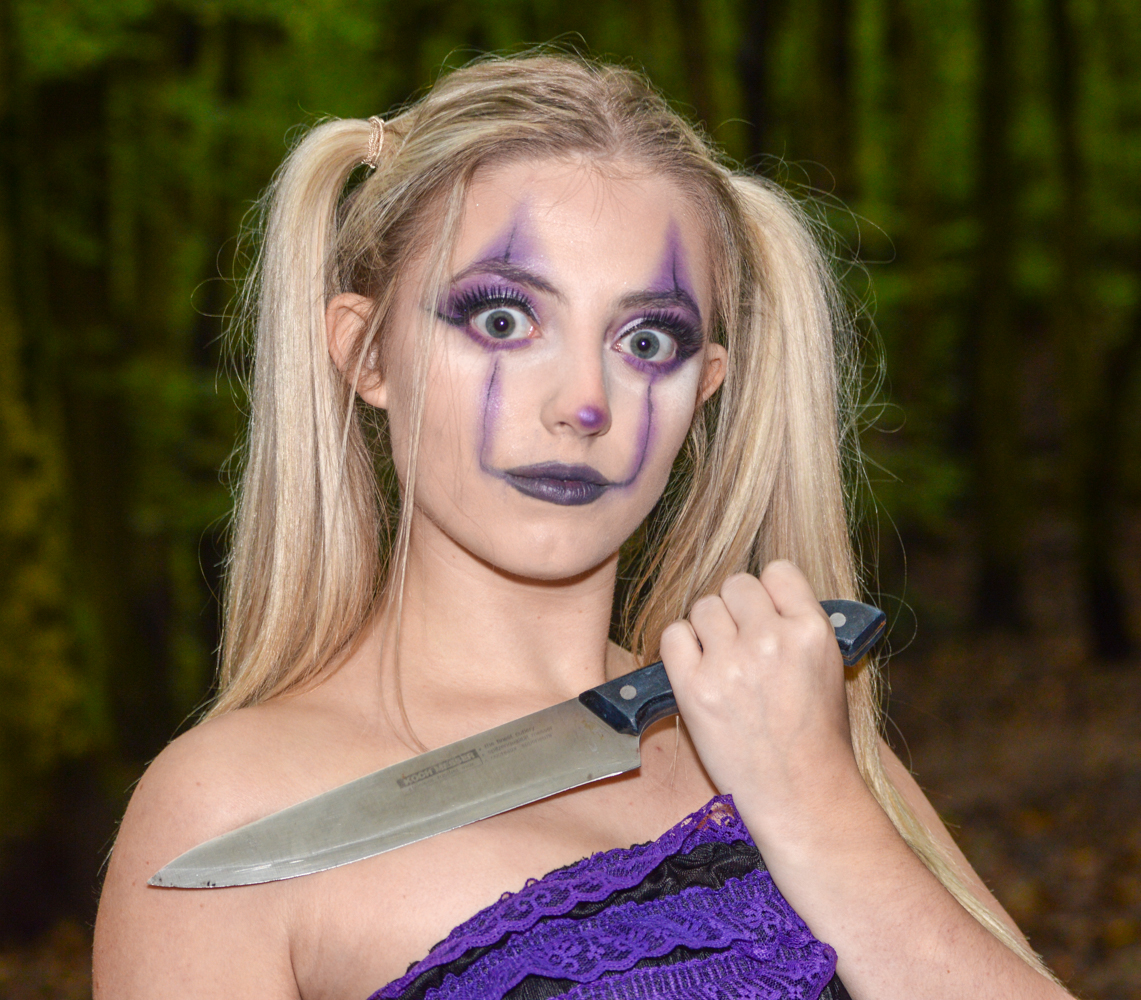
The look I chose was a modern-day Harlequin/ Pennywise look. According to the Oxford English dictionary, a Harlequin is a mute character in traditional pantomime, typically masked and dressed in a diamond-patterned costume. However, I choose to simply get harlequin makeup done by a makeup artist and my model wore a purple tutu dress. Harlequin comes from the french Hellequin, the name of the leader of a legendary troop of demon horsemen.
The other photographer chose a corpse bride/ghostly look. Corpse bride was a 2005 Tim Burton animation where a man about to be married accidentally places a ring on a dead womans finger thinking its a plinth and she comes back to life thinking they are married. Im unsure whether the other photographers intention was to have it appear as though she dies and comes back to life but this is what i wanted to capture through my images.
This time the location chosen was a woodland setting and as part of my idea we used smoke bombs for part of the shoot. This was the most difficult part as you cannot touch them when your lighting them and they can accidentally catch fire. The smoke will also just flow in the direction it desires.
Killa Halloween
My second halloween shoot was for a new clothing company called Killa Clothing. They sell Tshirts and hoodies for men and women.This time Killa clothing hired two special effects makeup artists to do halloween makeup on the models. I went to go and take the images when the makeup was done at a woodland location and a bridge over a train track. Here is the photos from both shoots both shot on Nikond3200 with a 55200mm lens and a 35mm prime lens:
If you enjoyed this post stay tuned for more and follow me on social media @lucyandthelens
A lot of people think that Day Of Dead and Halloween are interrelated. However they are two different festivals that appear to unintentionally connect in a number of ways. As stated on the National Geographic website Halloween is a dark night of terror whereas day of the dead or Dia De Los Muertos celebrates our love for those we have lost. The people who celebrate this believe in spirits and use literary Cavaveras which are short poems like a satire that make fun of the living. They also have official flowers called Cempazuchiti which are believed to attract ghosts.
According to www.metro.co.uk website it states that Halloween came from the Celtic Samhain which marked the night where spirits could pass through and the distinctions between the living and dead were blurred. it is combined with the Roman Feralia which commemorates the passing of the dead and honours Pomona the goddess of fruit, which is why we have apple bobbing.
Day Of The Dead Shoot
For as long as i can remember i have been a fan of using skulls in art pieces and for decoration so a couple of weeks ago I organised a Day Of The Dead shoot with Mentally Fit Sam and Aara Beauty. I planned to shoot the doing the makeup shots with a flash in my bedroom and then go to Avenham and Miller Park. However instead I ended up working with another photographer in his studio in Preston called Open Air Studio North West. This was my first collab using a makeup artist as well as a model and I chose to do a Day Of The Dead themed shoot due to my strange love of skulls.
For The Day Of The Dead Shoot we used a red gel on a flash behind the subject which created a more halloweeny feel and made the makeup stand out more. I used my Nikon d3200 with 55-200mm telephoto zoom lens for the majority of the shoot to obtain close ups of the makeup look. However for the aerial hoop shots I decided to add more depth to my image by using my Nikon 18-55 mm lens so more of the body was visible as Sam performed aerialist manoeuvres.
Halloween Shoot
On the 13/10/2018 i went to a photography session days event at Atlas Studios where there was a mystery set which was zombies. This fits perfectly with the Halloween theme. There were also some bloody knives over a door which enhanced this. I framed her under these to add to the terror of Halloween. I also enjoyed using the strobe under the stairs as it added a dark and moody feel to the zombies. The zombies caged and trying to break out adds a conventional, zombie movie-esque horror to the images and creates a sense of escape from reality.
Here is a selection of my images from both of the shoots:
I hope you enjoyed this post and for more stay tuned and check out my Instagram @lucyandthelens.
“An artists vision creates the image; the camera simply captures it.” This is the opening line of the book and also the most important. Before you even pick up the camera you must have an idea of what you want to create as the camera doesn’t do the work for you, you have to do that yourself.
Lenses
Lara’s description of lenses opened up a whole new world to portraiture for me. I usually tend to use my Nikon 70-200 mm telephoto zoom lens for portraiture, but Lara suggested that instead a wide angle lens can introduce a dynamic angle of view and distort an image excitingly. She also recommends using a macro lens for extreme close –up beauty work which is something Id like to try.
Photographing with movement
Photographing your subject mid-movement creates a dynamic shot and adds interest to the image. Lens baby creates creative lenses.A fast shutter speed freezes motion, and a slow shutter speed blurs movement. Manual focus works better for fashion shots as it allows you to focus on an eye or a strand of hair.
Preparing
To prepare to decide beforehand what you want out of the shoot and create mood boards or Pinterest boards before every shoot. Look on websites to find models and If you can’t afford a stylist choose or source the clothes yourself. Have a plan for whether you want a location shoot or a studio shoot. Decide which will work best.
Shooting
Location shoots are better for new models or clients, and studio shoots are better for experienced models. High key lighting creates a comfortable dynamic to an image, and low key lighting adds a dramatic mood to an image. The best time to shoot in natural light is the first hour after sunrise and the last hour before sunset referred to as the golden hour by landscapers. The light during these hours is soft and diffused, the angle low, and the colour warm. Don’t be afraid to experiment with over and under exposure to natural light. Use one softbox to provide soft and flattering light to your subject. Use a white reflector to highlight your subject and a black reflector on the right side of your subject to add contrast and for more variation use a black backdrop. Experiment with different coloured lights. Use a silver umbrella with a white backdrop for clear, detailed high key images. To enhance makeup use a beauty dish as your light source. Backlight create beautifully And visually dramatic photos. Add a second light for a simple backlit portrait. Use a softbox to flatter the subject and a second light behind to illuminate them. Try using natural light in the studio and enhancing it with reflectors. Use two white reflectors on either side to bounce the light back and a gold reflector to add warmth to the shot.
Personal Assignments
Setting yourself assignments is also vital as it helps you to find your style. Then Lara Jade sets us tasks to be open to our interpretation which I will discuss at a later stage as I’m going to give them a go. I’ve made several assignments personal to me; I’m planning a childhood memories project which I am accepting ideas of things to recreate. My crystal ball project is continuously ongoing and also the subject of my latest blog. I also like to showcase my hobbies in my work, and I’m planning a few special projects using models. The working photographer You need to be able to work closely with people, stick to a brief and create your own. Charge what you believe is a fair price for your time but never lose your integrity.
Retouching
To make your images pop this is something that is typically done after a shoot. I used to use photoshop files with many layers so I can always go back and adjust. Now I have changed my editing process using Lightroom to batch edit and then using photoshop to fine-tune whichever images I feel need more work. Lara states that she applies layer masks to create composites which is something I haven’t tried but id like to give a go. You can use curves to change the tone of an image by using it on the RGB channel. Use a hard healing brush to correct skin blemishes or use the spot healing brush or a clone stamp tool. Use textures to add a vintage film feel to your image. In Photoshop You can turn an image into black and white by creating a channel mixer adjustment layer by going to layer>new adjustment layer>channel mixer. Click the monochrome box. Move the RGB sliders. Then form a selective colour adjustment layer and select neutrals and move blacks slider to +30. For more contrast then select blacks and mover the slider to +10 or +20.
Marketing
Think about who your intended market is. Use push marketing to showcase your photography to potential clients, art buyers and directors. Also, pull marketing uses social media and word of mouth to create your brand. Think about your brand and how it appears to clients. Prepare both a physical and an online portfolio.
I hope you enjoyed this post and you stay tuned for more of what I’ve been reading and shoots I’ve done recently.
At the beginning of the year, I set myself 30 photography related goals. Currently, I have started 11 of them, and today I am going to talk about goal number 24 which was to begin using props within my photography.
My First prop of 2018 is a Crystal Ball because this is something I’ve wanted to try for a long time. Crystal ball photography is a type of photography that distorts your image, simularly to a fisheye lens except your subject will appear upside down inside the ball, which is the main reason it appeals to me. I also started following the #crystalballphotography on Instagram to find inspiration.
The first time I used it was sometime in mid-February when it snowed overnight, so I went into my garden the next morning and experimented with my Nikon D3200, my iPhone 8+, and my crystal ball.
I decided my sigma 10-20mm (wide angle lens) was the best one to use for this experiment, so I placed my crystal ball on my garden wall making sure I had foliage behind and shot at ISO 100 but kept varying the aperture and shutter speed to achieve a variety of different photos. I decided that the crystal ball in the snow tended to look better in black and white, so I adjusted this in the post-processing in Lightroom. I did this by taking down the contrasts and highlights and upping the shadows and exposure and then converting my image to black and white.
I also used portrait mode on my iPhone 8+ to test a variety of different types of lighting my crystal ball and edited these in photoshop express. My favourite set-up in portrait mode is the stage lighting in black and white as I felt it made the snow stand out.
The Second time with my Crystal Ball I went to Beacon Fell with a friend who held the crystal ball for me while I photographed some sunsets. Anyone who knows me knows that this is a type of shot I thoroughly enjoy taking so I couldn’t wait to try a new approach.
Finally the third time I took my crystal ball out it was also snowing except this time I went to Avenham Park using the landscape as my backdrop.
Here is a gallery of my Crystal Ball photos:
If you enjoyed my article be sure to keep checking out my website and for further reading check out what other bloggers have written about this topic in the links below:
So I thought I’d kick of 2018 by setting some goals to help me focus on how to move forward with my photography. So here is a list of what I want to achieve this year:
Sort Out Business Cards.
Enter National and International Competitions.
Start Putting my Ideas into Motion.
Start a hashtag a day project on twitter in order to improve my marketing strategy.
Start a 52 Week project and document it on my Blog.
Photograph more things outside my comfort Zone.
Interview other Photographers.
Do more solo days out.
Think more about the stories I want to tell, than the technical aspect.
Set more creative challenges for myself to refocus my vision.
Regularly Update my blog whenever I do new work.
Join some photography sites and upload images at least once a week i.e. update viewbug, Flickr.
Get more feedback from other photographers and make a note of it all.
Learn how to shoot with a new lens: Got a Fisheye 5.8mm for Christmas so will start with this.
Try new photographic software i.e. Luminar or Pixlr.
Create A Schedule for Taking Photos.
Shoot more personal projects.
Sort all Photos into dated folders for easy navigation.
Create more time-lapse videos.
Start doing a few tutorials.
Learn a new type of photography.
Study more techniques by reading books and doing courses.
Listen to photography podcasts.
Buy some creative props- not going to give this away just yet but I have two in mind.
Get rid of what’s holding me back.
Focus more on the blogging and business aspect of photography.
Talk about the why – Why do I do photography?
Finish the projects I started in 2017.
Photograph a completely new place.
Take more photographs.
Lets start the new year right by working through these in the upcoming months. Hopefully these goals are all achievable and im looking forward to the year ahead.
The first challenge is to write a list post and I thought seen as I’ve been busy lately I’d make a list of 10 ideas to unleash the creative photographer within you. This list is typically what I might do on a week when I have very little time to get out and about and photograph. This keeps me focused on getting out and about and not giving up because my time is limited. So here is just a few ideas of things i like to do to get inspired to photograph:
Find a local museum, familiarise yourself with the exhibits and challenge yourself to photograph every new exhibit. Sometimes I spend one day a week just wandering round the Harris Museum in Preston with my camera seeing what i can discover.
Create a series about something your passionate about. For me this could be reading, reinterpretting movie scenes through photographs, portraiture or fencing.
Turn yourself into an alter ego. If time contraints mean you don’t have a model this week why not take pictures of yourself in your normal state and showing different aspects of your personality. You can also create an entirely new persona of yourself by wearing something different or doing something that isnt usual for you.
Create a campaign about something just for yourself. I haven’t done this yet but i’m hoping to work on a few different ones but i’m not going to give anything away, just yet.
Get on a train and go somewhere alone and document your day.
Spend your day in a familiar place and find new ways of looking at it.
Go for a walk to focus your mind. I find that going for walks really helps me to clear my head and form ideas for new projects.
Only use one lense. This helps to improve your composition as your really have to think about making use of what you’ve got. Here is a more indepth explanation of why you should do this challenge: One Lense Challenge.
Add a signature motif to one of your images during a day shoot. I’ve seen this done many times by various photographers. Usually something simple like A Red Umbrella or a Yellow Coat.
Invest your personality into your images.
I hope you enjoyed this post. Here is a few photos taken during these challenges: